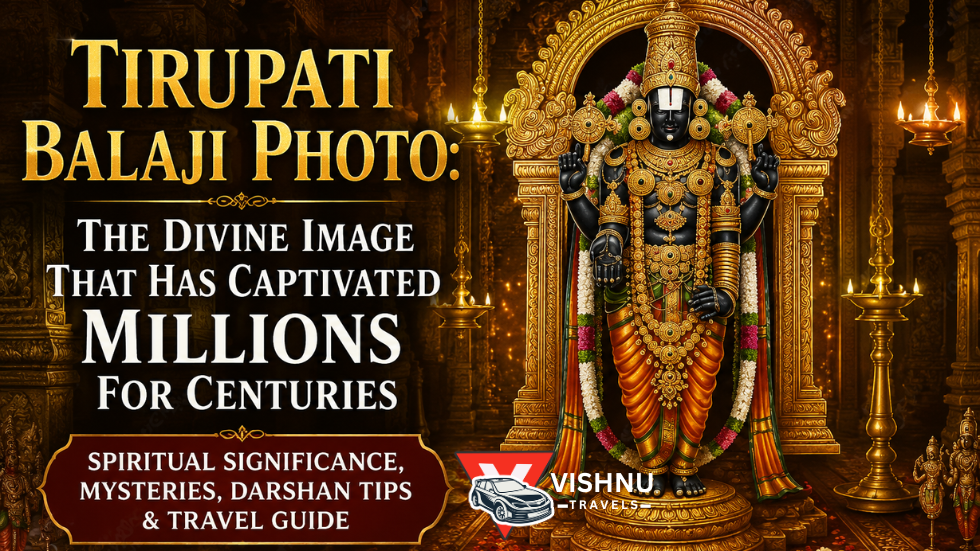
There’s something that happens to people the moment they lay eyes on a Tirupati Balaji photo. A stillness. A catch in the breath. For millions of Hindus across the world, a single glance at the sacred image of Lord Venkateswara is not just an act of seeing — it’s an act of prayer. Whether it’s framed above a doorway in a Chennai apartment, saved as a phone wallpaper in New Jersey, or printed on a poster in a Hyderabad office, the photo of Tirupati Balaji carries a spiritual weight that goes far beyond pixels and paper.
But what makes this image so profoundly powerful? Why does the Tirupati Balaji photo draw such intense devotion even in its reproduced form? And what does the real idol in the sanctum of Tirumala actually look like?
This guide answers all of that — and helps you plan a visit to see it all for yourself.
Who Is Tirupati Balaji? Understanding the Deity Behind the Image
Before we talk about the photo, we need to understand the God.
Lord Venkateswara — popularly called Tirupati Balaji, Govinda, or Srinivasa — is a form of Lord Vishnu. He is believed to have descended to earth during the Kali Yuga (the current cosmic age) specifically to save humanity from suffering and sin. The place of his dwelling, Tirumala, is hence known as Kaliyuga Vaikuntha — the heavenly abode of God in this era.
The name Venkateswara itself is deeply meaningful: “the Lord who destroys the sins of those who surrender to him.” This is precisely why devotees flock to the temple — and why the Tirupati Balaji photo is treated not merely as an artistic representation, but as the direct presence of the divine.
His divine consorts — Goddess Lakshmi (Sridevi) and Goddess Padmavati (Bhudevi) — are always with him. Lakshmi rests her form on his right chest, and Padmavati on his left shoulder, symbolizing divine compassion that encompasses all creation.
What Does the Original Tirupati Balaji Idol Actually Look Like?
The original idol of Lord Venkateswara at Tirumala is one of the most astonishing divine images in the world — visually and spiritually.
- Height & Material: The idol stands approximately 8 feet tall, carved from black stone (believed to be Shaligrama stone), radiating an otherworldly divine glow.
- Swayambhu Murti: Unlike most temple idols sculpted by artisans, this image is considered Swayambhu — self-manifested. It was not made by human hands but divinely appeared in the sanctum sanctorum, believed to be over 5,000 years old.
- Real Hair: Perhaps the most miraculous feature of the idol — the hair on Lord Balaji’s head is real. Temple priests confirm the hair never tangles, never dries, and is always soft. Some devotees believe it continues to grow.
- The Sweating Idol: The idol is said to perspire. Priests maintain a thin veil of cloth against the back of the idol, and it is reportedly always moist — a phenomenon that has puzzled scientists and deepened the faith of believers.
- Goddess Lakshmi’s Presence: On the right side of the Lord’s chest, there is an embedded image of Goddess Lakshmi — symbol of wealth and prosperity — reminding devotees that where Balaji is, Lakshmi follows.
- Shankha and Chakra: The Lord holds a conch (Shankha) and discus (Chakra) — the divine weapons of Vishnu — symbolizing protection, cosmic order, and justice.
- The Divine Tilak: A golden Namam (tilak) adorns the forehead of the idol. It is said to represent both the divine eye and the mark of justice — Lord Balaji is called the God of Justice, blessing the righteous and correcting the wayward.
What many pilgrims feel during darshan — and what devotees sense even from a Tirupati Balaji photo — is this overwhelming combination of power, compassion, and presence radiating from every element of the deity’s form.
The Significance of a Tirupati Balaji Photo in a Devotee’s Life
It’s a common sight in South Indian homes: a framed photo of Lord Balaji placed at the entrance, in the puja room, or above the dining area. This is not tradition for tradition’s sake.
In Hindu philosophy, the photo or image (murti) of a deity is considered a living medium of divine energy. When a devotee sees the Tirupati Balaji photo with sincerity and devotion — even at home — it is believed to:
- Invite the blessings of Lord Venkateswara into the household
- Attract prosperity and remove financial obstacles (as Lakshmi resides on his chest)
- Provide protection from negative energies
- Serve as a daily spiritual anchor, reminding the devotee of surrender and humility
Displaying the photo facing east or north, keeping it clean and adorned with flowers, and lighting a lamp before it — these are simple acts that deepen the connection between the devotee and the divine.
Many pilgrims who have made the journey to Tirumala say that the Lord Balaji photo on their wall “feels different” after the darshan — as if charged with a personal blessing from the mountain itself.
The Temple Behind the Photo: Tirumala’s Sacred Geography
The Sri Venkateswara Swami Temple, set atop the Tirumala hills in Andhra Pradesh, is one of the most visited pilgrimage destinations in the world. Every year, over 40 million devotees climb or drive to this sacred summit — more annual visitors than the Vatican and Mecca combined.
The temple sits at 853 metres above sea level, perched across seven peaks — said to represent the seven hoods of Adisesha, the divine serpent on whom Lord Vishnu eternally rests. This geography itself is sacred; the hills are believed to be a fragment of Mount Meru (the cosmic mountain of Hindu cosmology) brought to earth by Garuda, Vishnu’s eagle mount.
The temple architecture is a stunning example of Dravidian style — towering gopurams (gateway towers) covered in intricate carvings, golden domes, and mandapams (pillared halls) that have witnessed centuries of unbroken worship. Built around the 9th century CE and patronized over the centuries by the Pallavas, Cholas, and the Vijayanagara kings, it stands today as one of India’s most treasured religious monuments.
Mysteries Surrounding the Tirupati Balaji Temple
Every photo of Lord Balaji and the temple seems to capture something that cannot quite be explained — because the temple itself is filled with phenomena that defy logic.
The Ocean Sound Behind the Idol Visitors and priests report hearing the faint sound of ocean waves from behind the main idol — even though Tirumala is hundreds of kilometres from the sea. No scientific explanation has been offered.
Flowers That Never Wilt Flowers offered to Lord Balaji at Yerpedu (a nearby town) reportedly appear fresh on the deity’s idol — without any visible transportation. Priests confirm this has happened repeatedly over many decades.
The Hidden Village Approximately 22 kilometres from the temple lies a village known only to a select few. All the sacred offerings used in daily worship — flowers, milk, ghee — come from this village. No outsider has ever seen it. Some believe the villagers are descendants of ancient sages, divinely chosen to serve the Lord.
Eternal Lamps Flames within the sanctum have reportedly burned continuously for centuries, never extinguished, without any visible source of fuel being added.
These mysteries are part of why the Lord Balaji photo carries a weight no mere photograph should be able to carry. Behind that image is a living phenomenon.
The Sacred Rituals: What Happens Inside the Temple Every Day
The daily rhythm of worship at Tirumala is a masterpiece of devotion and precision. Understanding these rituals enriches every Tirupati Balaji image you’ll ever see.
- Suprabhata Seva – The Lord is awakened before dawn with Vedic hymns and divine music
- Thomala Seva – Garlands and tulsi leaves are offered to the deity
- Kalyanotsavam – A symbolic daily wedding between Lord Balaji, Goddess Lakshmi, and Goddess Padmavati
- Abhishekam – On Fridays, the idol is bathed with holy water, milk, turmeric, and sandalwood paste
- Sahasranamarchana – 1,000 divine names of the Lord are chanted
- Ekanta Seva – The final service of the day, where the Lord is put to rest
Each of these sevas is conducted according to the ancient Vaikhanasa Agama Shastra — a set of scriptures that has governed this temple’s worship for over a thousand years, without interruption.
Planning Your Tirupati Darshan: A Practical Guide
Seeing the Tirupati Balaji photo on your phone or wall is one thing. Standing before the Lord himself in the sanctum — that is something that changes a person.
Here’s how to plan your pilgrimage:
Darshan Timings The temple opens at 3:00 AM and closes at 9:30 PM. Darshan options include:
- Sarva Darshan – Free, but can take 8–12 hours of waiting
- Special Entry Darshan (SED) – Paid, faster access (book online via TTD portal)
- Divya Darshan – For foot pilgrims who trek up Alipiri or Srivari Mettu
What to Carry Wear clean, traditional clothes (saris for women; dhoti or formals for men). Carry your ID proof. Mobile phones and cameras are not permitted inside the sanctum — which is why the Tirupati Balaji photo you treasure must be found outside the inner shrine.
Best Time to Visit October to February offers pleasant weather. Avoid major festival weeks (Brahmotsavam) unless you’re prepared for massive crowds.
How to Reach Tirupati
- By road from Hyderabad: ~10 hours (around 570 km)
- By train: Tirupati has an active railway station with connections to Hyderabad, Chennai, and Bengaluru
- By air: Tirupati Airport has connections to major cities
Travel from Hyderabad to Tirupati — Make It Easy with Vishnu Travels
For pilgrims starting their journey from Hyderabad, the road trip to Tirupati is actually a beautiful experience — passing through scenic Andhra Pradesh terrain, with the final ghat road winding up the Tirumala hills offering spectacular views.
But a pilgrimage should be about peace of mind, not logistics stress. That’s where Vishnu Travels steps in.
We offer comfortable, well-maintained vehicles for your Tirupati pilgrimage — from Hyderabad and surrounding areas. Whether you’re travelling as a family, a group of friends, or planning a solo spiritual retreat, we’ll take care of the journey so you can focus entirely on your darshan.
- Comfortable, AC vehicles
- Experienced, courteous drivers
- Flexible pickup timings (including early morning departures)
- Door-to-door service
📞 Call us: +91 9063404081 📧 Email: vishnutravels6509@gmail.com 🌐 Website: vishnu-travels.com
Before You Go: Spiritual Etiquette at the Temple
The Tirupati Balaji temple is not just a monument — it is a living sacred space. Honour it:
- Dress modestly. Traditional attire is preferred and respected.
- Maintain silence near the sanctum; chant the Lord’s names quietly.
- Do not attempt to photograph inside the temple — it is prohibited.
- Consider tonsuring (hair offering) if it is part of your vow — it’s a profound act of humility.
- Receive the famous Tirupati Laddu prasadam with gratitude; it is one of the most iconic offerings in Hindu devotion.
Conclusion: The Photo Is Just the Beginning
A Tirupati Balaji photo on your wall, your phone, or your puja shelf is a beautiful thing — a daily reminder of divine grace, an object of quiet devotion, a window to something larger than ordinary life.
But every image of Lord Venkateswara is also a calling.
It calls you toward the hills of Tirumala. Toward the ancient stone steps of Alipiri. Toward the thundering chants of “Govinda! Govinda!” that echo through the queue complexes. And finally, toward that breathtaking moment — just a few seconds long — when you stand before the original Tirupati Balaji idol and look into the face of the divine.
No photo can fully capture that. But it can remind you that it’s waiting.
Govinda! Govinda!