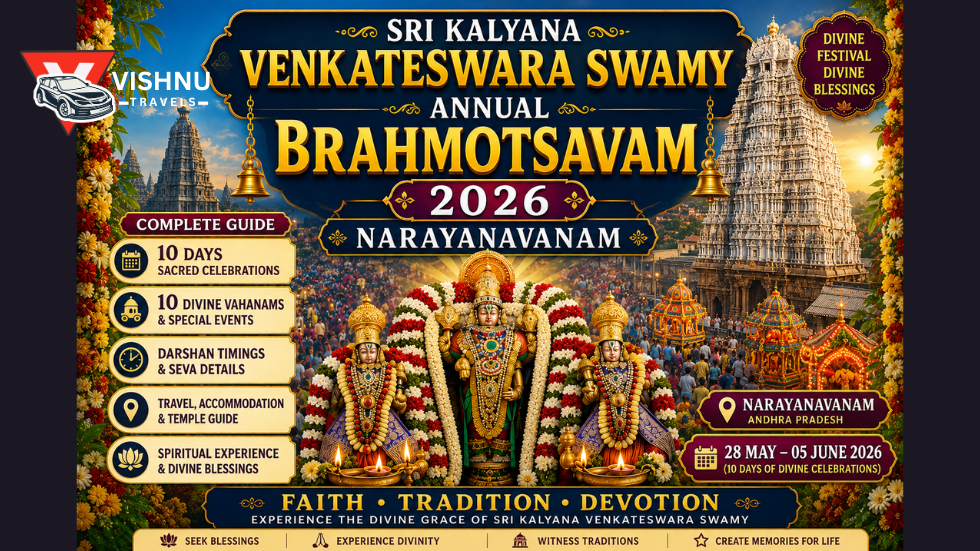
Every year, as the sacred month of Jyeshtha arrives, thousands of devotees from across Andhra Pradesh and beyond make their way to the ancient temple town of Narayanavanam. Their destination: the magnificent Sri Kalyana Venkateswara Swamy Temple, where the air fills with the fragrance of flowers, the rhythms of Vedic chanting, and the divine energy of one of South India’s most celebrated Brahmotsavam festivals. The Annual Brahmotsavam 2026 at Narayanavanam is set to be a spectacular nine-day celebration — a sacred event that unites faith, culture, and devotion in a way few festivals can.
If you are planning to attend the Narayanavanam Brahmotsavam 2026, this comprehensive guide will walk you through every aspect of the festival — from the schedule and vahana sevas to travel tips and accommodation options. Whether you are a first-time visitor or a seasoned pilgrim, this article will help you plan a deeply fulfilling spiritual journey.
About Sri Kalyana Venkateswara Swamy Temple, Narayanavanam
Located approximately 35 kilometres from Tirupati in the Chittoor district of Andhra Pradesh, Narayanavanam is home to one of the most revered temples in the Tirupati pilgrimage circuit. The Sri Kalyana Venkateswara Swamy Temple is dedicated to Lord Venkateswara in His most auspicious form — the wedding form (Kalyana Swarupa) — making it uniquely significant among all Vishnu shrines in the region.
According to temple legend, Lord Vishnu manifested here as Kalyana Venkateswara, the divine bridegroom, and it is believed that couples who worship here receive the Lord’s blessings for a harmonious and prosperous married life. The presiding deity, Sri Kalyana Venkateswara Swamy, is adorned in regal wedding attire, and the sight of the Lord in this form is considered extraordinarily auspicious.
The temple is administered by the Tirumala Tirupati Devasthanams (TTD), the same trust that manages the world-famous Tirumala Venkateswara Temple. TTD’s stewardship ensures that all rituals, festivals, and services at Narayanavanam are conducted with the highest standards of Agama Shastra — the ancient ritual science that governs temple worship in the Vaishnava tradition.
Over the centuries, the temple has drawn saints, kings, and ordinary devotees alike. Its stunning Dravidian architecture, with a towering gopuram and intricately carved mandapams, reflects centuries of patronage and devotion. The temple complex houses several subsidiary shrines, including those dedicated to Goddess Lakshmi, Andal, and the Alwar saints.
For pilgrims visiting Tirupati, a visit to Narayanavanam is considered an essential extension of the journey. The two temples together represent complementary aspects of Lord Venkateswara’s divine presence — His cosmic sovereignty at Tirumala and His intimate, personal grace at Narayanavanam.
What is Brahmotsavam?
The word Brahmotsavam derives from the Sanskrit “Brahma” (the creator god) and “Utsavam” (festival), and its origins lie in a beautiful piece of Puranic mythology. It is said that Lord Brahma himself approached Lord Vishnu and requested the honour of personally celebrating a festival in the Lord’s name. Moved by Brahma’s devotion, Lord Vishnu granted this wish — and the resulting celebration came to be known as Brahmotsavam, the Festival of Brahma.
In Vaishnavite tradition, the Brahmotsavam is considered the most important annual temple festival. It is a multi-day celebration during which the presiding deity is taken out in a grand procession on various divine vehicles — known as vahanas — each day. These vahanas are not merely decorative vehicles but carry profound theological symbolism, representing different aspects of the Lord’s divine nature and His relationship with the universe.
The Brahmotsavam follows a precise structure prescribed by the Pancharatra Agama texts — ancient Vaishnava scriptural codes that govern temple rituals. The festival begins with Dhwajarohanam (hoisting of the divine flag) and concludes with Dhwajavarohanam (lowering of the flag), and in between, devotees witness a series of spectacular vahana sevas — outdoor processions in which the Lord blesses the entire surroundings.
The TTD conducts Brahmotsavam celebrations at several temples under its management, and the Kalyana Venkateswara Swamy Brahmotsavam at Narayanavanam is one of the most cherished in the entire Tirupati region.
Narayanavanam Brahmotsavam 2026 Schedule
The Annual Brahmotsavam 2026 at Sri Kalyana Venkateswara Swamy Temple, Narayanavanam, runs from 28 May to 5 June 2026. Here is the complete day-wise schedule:
| Date | Day | Morning Seva | Evening Seva |
|---|---|---|---|
| 28 May 2026 | Day 1 | Dhwajarohanam | Pedda Sesha Vahanam |
| 29 May 2026 | Day 2 | Chinna Sesha Vahanam | Hamsa Vahanam |
| 30 May 2026 | Day 3 | Simha Vahanam | Muthyapu Pandiri Vahanam |
| 31 May 2026 | Day 4 | Kalpavruksha Vahanam | Sarvabhupala Vahanam |
| 01 June 2026 | Day 5 | Mohini Avataram | Garuda Vahanam |
| 02 June 2026 | Day 6 | Hanumantha Vahanam | Gaja Vahanam |
| 03 June 2026 | Day 7 | Suryaprabha Vahanam | Chandraprabha Vahanam |
| 04 June 2026 | Day 8 | Rathotsavam | Ashwa Vahanam |
| 05 June 2026 | Day 9 | Chakrasnanam | Dhwajavarohanam |
Day-Wise Brahmotsavam Celebrations — Spiritual Significance and Symbolism
Day 1 — 28 May 2026: Dhwajarohanam & Pedda Sesha Vahanam
The festival begins with the solemn and auspicious ceremony of Dhwajarohanam — the hoisting of the sacred Garuda Dwaja (flag bearing the image of Garuda) on a towering flagpole in front of the temple. This ceremony marks the formal commencement of the Brahmotsavam and signals to the entire universe that the Lord is about to celebrate His festival. Devotees believe that the moment the flag is hoisted, all celestial beings — devas, rishis, and divine serpents — assemble invisibly to participate in the festivities.
In the evening, the Lord is taken out in procession on the Pedda Sesha Vahanam — a grand vehicle in the form of Adisesha, the cosmic serpent. Adisesha, who serves as the eternal bed of Lord Vishnu in the primordial cosmic ocean, symbolises infinite time, cosmic stability, and unwavering devotion. Riding on Adisesha, the Lord blesses His devotees with the assurance of His eternal presence and protection.
Day 2 — 29 May 2026: Chinna Sesha Vahanam & Hamsa Vahanam
The second day begins with the Chinna Sesha Vahanam — the smaller version of the serpent vehicle. While Pedda Sesha represents the vast cosmic ocean of existence, Chinna Sesha symbolises the Lord’s accessibility — His willingness to descend to the level of His devotees and bless them in an intimate, personal way.
The evening brings one of the most poetic vahana sevas of the festival: the Hamsa Vahanam. Hamsa is the divine swan, traditionally associated with Saraswati, the goddess of wisdom. The Lord riding the Hamsa vehicle signifies that He is the source of all true knowledge, discrimination, and spiritual wisdom — for the swan is said to possess the legendary ability to separate milk from water, symbolising the discernment that comes from divine wisdom.
Day 3 — 30 May 2026: Simha Vahanam & Muthyapu Pandiri Vahanam
Simha Vahanam — the lion vehicle — dominates the third morning. The lion is the king of the jungle and embodies royal power, fearlessness, and divine majesty. The Lord riding the Simha Vahanam is a magnificent reminder that He is the supreme sovereign of the universe, and that all enemies of righteousness — both internal (ego, desire, ignorance) and external — are vanquished in His presence.
The evening’s Muthyapu Pandiri Vahanam is one of the most visually breathtaking events of the entire Brahmotsavam. The vehicle is decorated with a canopy of pearls — muthyalu — creating a shimmering, luminous pavilion around the deity. This vahanam symbolises divine abundance, purity, and the Lord’s radiance. Seeing the deity adorned under the pearl canopy at dusk is an experience devotees cherish for a lifetime.
Day 4 — 31 May 2026: Kalpavruksha Vahanam & Sarvabhupala Vahanam
The Kalpavruksha Vahanam recalls the mythological wish-fulfilling tree that grows in Indra’s paradise — a tree that grants every desire of those who approach it. The Lord appearing on this vehicle signals that He Himself is the ultimate wish-fulfilling power — that genuine prayer and surrender to Him will never go unanswered.
In the evening, the Sarvabhupala Vahanam — literally “the vehicle of all kings” — presents the Lord as the emperor of all sovereigns, the ruler above all earthly rulers. This vahanam reminds devotees that all worldly authority is ultimately subordinate to divine grace, and that the true king is He who governs the universe with compassion and righteousness.
Day 5 — 1 June 2026: Mohini Avataram & Garuda Vahanam
The fifth day is among the most anticipated days of the Narayanavanam Brahmotsavam 2026. In the morning, the Lord is depicted in the captivating form of Mohini — the enchantress avatar assumed by Vishnu to retrieve the nectar of immortality (amrita) from the asuras during the churning of the cosmic ocean. This avatar represents the Lord’s infinite capacity for illusion (maya) and His use of divine play (leela) to restore cosmic order.
But it is the evening that devotees wait for with the greatest expectation: the magnificent Garuda Vahanam. Garuda — the king of birds and the divine eagle who serves as Lord Vishnu’s mount — is considered one of the most sacred vahanas in Vaishnavite tradition. Garuda symbolises the Vedas themselves, spiritual speed, freedom from bondage, and the swift flight of the soul toward liberation. When the Lord is seated on Garuda and taken in procession through the streets, the atmosphere becomes electrifying. Devotees fall to their knees, tears flow freely, and the chanting of “Govinda Govinda” reaches a crescendo. This is widely considered the spiritual peak of the entire Brahmotsavam.
Day 6 — 2 June 2026: Hanumantha Vahanam & Gaja Vahanam
Hanumantha Vahanam commemorates the devotion of Lord Hanuman — the perfect bhakta (devotee) who serves Lord Rama with absolute selflessness. The Lord riding Hanumantha Vahanam teaches devotees the supremacy of surrender and bhakti — that the path of devotion is the surest way to reach the divine.
The Gaja Vahanam in the evening features the Lord seated on a magnificent elephant. In Indian tradition, the elephant represents Ganesha’s blessing, auspiciousness, regal grandeur, and earthly prosperity. The Lord on Gaja Vahanam blesses devotees with material wellbeing, dignity, and the removal of obstacles on their path.
Day 7 — 3 June 2026: Suryaprabha Vahanam & Chandraprabha Vahanam
Day seven presents a beautiful cosmic pairing. In the morning, the Suryaprabha Vahanam — the sun vehicle — displays the Lord as the source of all light, energy, and life in the universe. The sun sustains all creation, and the Lord riding the Surya vehicle reminds devotees that the divine is the ultimate source of consciousness and vitality.
The evening brings the Chandraprabha Vahanam — the moon vehicle. While the sun represents active energy and enlightenment, the moon symbolises serenity, reflection, and the mind. Together, the Surya and Chandra vahanas represent the complete spectrum of the Lord’s cosmic presence — from the blazing light of divine knowledge to the gentle glow of peace and inner calm.
Day 8 — 4 June 2026: Rathotsavam & Ashwa Vahanam
The eighth day is dominated by the grandest event of the entire festival: Rathotsavam — the chariot festival. On this day, the Lord is seated in a massive, ornately decorated wooden chariot (ther) and drawn through the streets by thousands of devotees pulling thick ropes. The Rathotsavam of 4 June 2026 will see the entire Narayanavanam town come alive with devotion.
In Vaishnava theology, the chariot represents the human body — the vehicle of the soul’s journey through earthly life. The Lord riding the chariot is a symbolic reminder that He agrees to dwell within us, to guide our journey, if only we open ourselves to His presence. Pulling the rope of the Lord’s chariot is considered one of the most meritorious acts a devotee can perform, believed to wash away sins and grant liberation.
The evening closes with the Ashwa Vahanam — the horse vehicle. The horse represents the Kalki avatar — Vishnu’s prophesied tenth and final incarnation, who will appear at the end of this cosmic age to restore righteousness. The Ashwa Vahanam signals the Lord’s eternal readiness to act, to ride forth, and to restore dharma whenever it is threatened.
Day 9 — 5 June 2026: Chakrasnanam & Dhwajavarohanam
The final day of the Brahmotsavam 2026 carries a particular solemnity. In the morning, the sacred Chakrasnanam ceremony takes place at a water body (theertham) near the temple. The Sudarshana Chakra — the divine discus of Lord Vishnu — is brought in procession to the water, and the theertham is sanctified by this immersion. Devotees flock to bathe in this water, believing that the Chakrasnanam theertham carries the power to cleanse sins, heal ailments, and grant liberation.
The Sudarshana Chakra is not merely a weapon but a symbol of the Lord’s cosmic will — the force that removes all obstacles, destroys all evil, and keeps the universe in perfect order. Bathing in the Chakrasnanam theertham is thus an act of surrender to this divine power.
The festival concludes in the evening with Dhwajavarohanam — the lowering of the sacred flag. As the flag descends, devotees experience a bittersweet mixture of fulfilment and gentle sadness, knowing that this year’s Brahmotsavam has drawn to a close. It is customary for devotees to pray that they may return for the next year’s celebrations.
The Special Significance of Garuda Vahanam
Of all the vahana sevas conducted during the Brahmotsavam, the Garuda Vahanam holds a unique and supreme place in the hearts of Vaishnava devotees. Garuda is described in the Puranas as the king of birds, born of the sage Kashyapa and the divine Vinata, and is inseparably bound to Lord Vishnu as His eternal vehicle and companion.
Theologically, Garuda represents the Sama Veda — the Veda of music and devotion — and is also seen as a symbol of the individual soul (jiva) that rises above the material world toward the Supreme. Just as Garuda soars above all earthly creatures, the devotee who surrenders to Lord Vishnu transcends the cycle of birth and death.
There is also a deeply personal aspect to the Garuda Vahanam: it is said that Lord Vishnu, who reclines on the cosmic serpent Adisesha in Vaikuntha, always rides Garuda when He moves. To see the Lord on Garuda is thus to witness Him in His most active, most accessible, most dynamic form — coming out to meet His devotees, descending from the celestial realm into the world of humans.
The Sacred Importance of Rathotsavam
Rathotsavam is the jewel of the Brahmotsavam celebrations. On 4 June 2026, the streets of Narayanavanam will witness tens of thousands of devotees converging to pull the Lord’s chariot. The sheer scale of collective devotion on display during Rathotsavam is something that must be experienced to be understood.
The theological depth of the chariot festival is immense. The Bhagavad Gita itself uses the chariot as a central metaphor — Arjuna in the chariot guided by Krishna represents the soul on its journey through life, guided by the divine. The Rathotsavam enacts this metaphor in physical reality: devotees become the horses, the ropes become the reins of surrender, and the Lord in the chariot becomes the divine charioteer of every devotee’s life.
For those who can attend only one day of the Brahmotsavam, 4 June 2026 is the day to be at Narayanavanam.
The Purifying Power of Chakrasnanam
Chakrasnanam on 5 June 2026 is the final and deeply purifying event of the Brahmotsavam. In Hindu tradition, the act of bathing in sacred water bodies (theerthams) is believed to remove the accumulated karma of many lifetimes. When the Sudarshana Chakra is immersed in the theertham, the water is believed to become infused with divine power, capable of granting freedom from sin (papa) and even liberation (moksha).
Ancient texts describe the Sudarshana Chakra as the Lord’s cosmic will made visible — a spinning disc of pure divine energy that annihilates all that opposes dharma. To bathe in waters touched by the Chakra is to symbolically request that this divine energy cleanse one’s consciousness and remove all karmic obstacles.
Devotees who have participated in the Chakrasnanam at Narayanavanam describe the experience as profoundly transformative — a feeling of lightness, peace, and renewed spiritual commitment that stays with them long after the festival ends.
Best Time to Visit During the Brahmotsavam
Every day of the Brahmotsavam has its own unique beauty, but some days draw particularly large crowds and offer especially powerful spiritual experiences:
Day 1 (28 May) — Dhwajarohanam is a deeply ceremonial occasion, perfect for those who wish to experience the ritual beginning of the festival.
Day 5 Evening (1 June) — Garuda Vahanam is widely considered the spiritual high point of the entire nine days. Arrive early to secure a good viewing position.
Day 8 Morning (4 June) — Rathotsavam is the most visually spectacular event. Be prepared for very large crowds and plan to arrive several hours before the procession begins.
Day 9 Morning (5 June) — Chakrasnanam is deeply spiritual and less chaotic than Rathotsavam, making it ideal for those seeking a quieter but profoundly meaningful experience.
Travel Guide for Devotees — How to Reach Narayanavanam
By Air
The nearest airport to Narayanavanam is Tirupati Airport (IATA: TIR), located approximately 40 kilometres away. Tirupati Airport has regular flights connecting to Hyderabad, Bengaluru, Chennai, Delhi, and Mumbai. From the airport, cabs and autos are available to Narayanavanam.
By Train
Tirupati Railway Station is the most convenient railhead, with excellent connectivity to all major cities in South India and beyond. From Tirupati Railway Station, Narayanavanam is approximately 35 kilometres. Taxis, autos, and shared vehicles are readily available.
By Road
Narayanavanam is well connected by road to Tirupati, Chennai, Bengaluru, and Hyderabad. State-run APSRTC buses operate regular services from Tirupati Bus Stand. Private cabs offer a more comfortable and convenient option, especially for families and groups.
For a seamless travel experience, Vishnu Travels offers dedicated cab services from Tirupati to Narayanavanam, tailored specifically for pilgrims attending the Brahmotsavam. Their drivers are experienced with temple town routes and can ensure you reach the temple well in time for the vahana seva of your choice.
📞 Contact Vishnu Travels: +91 9063404081 🌐 Website: https://vishnu-travels.com/ 📧 Email: vishnutravels6509@gmail.com
Accommodation Options Near Narayanavanam
Accommodation options in Narayanavanam itself are limited, which makes Tirupati the most practical base for devotees attending the Brahmotsavam. Tirupati offers a wide range of lodging options:
TTD Guest Houses and Choultries — The Tirumala Tirupati Devasthanams runs several guest houses and free choultries (dharmashalas) in and around Tirupati. These need to be booked in advance through the TTD online portal.
Budget Hotels and Lodges — Numerous budget hotels are available in Tirupati town, particularly around the bus stand and railway station area.
Mid-Range Hotels — Several well-appointed hotels with all standard amenities are available for pilgrims seeking a more comfortable stay.
Premium Hotels — Tirupati also has a selection of premium hotels and resorts for those who prefer luxury.
Given that the Brahmotsavam is a peak pilgrimage season, it is strongly advisable to book accommodation at least 4–6 weeks in advance.
Why Visit Narayanavanam During Brahmotsavam?
The Narayanavanam Temple Festival during Brahmotsavam offers something that few religious events in South India can match: an unbroken nine-day immersion in the devotional culture of the Vaishnava tradition. Each vahana seva is a different window into a different aspect of the divine, and attending multiple days allows devotees to experience the full spectrum of Lord Venkateswara’s grace.
Beyond the religious significance, the Brahmotsavam is also a cultural celebration of the highest order. The music of the Melam (temple orchestra), the fragrance of jasmine and tulasi garlands, the sight of the deity adorned in jewels and silks under the open sky — these sensory experiences create memories that last a lifetime.
For families with children, the Brahmotsavam is an extraordinary opportunity to transmit living traditions of faith and devotion, allowing young minds to experience firsthand the cultural and spiritual heritage of Andhra Pradesh.
Travel Tips for Devotees
- Plan accommodation early. Narayanavanam and Tirupati fill up quickly during the Brahmotsavam. Book at least 4–6 weeks in advance.
- Arrive well before the vahana seva. Popular sevas like Garuda Vahanam and Rathotsavam draw enormous crowds. Arriving 2–3 hours early will help you find a good viewing spot.
- Dress modestly. Traditional dress — sarees for women, dhoti or kurta-pyjama for men — is appreciated and customary at the temple.
- Carry water and light refreshments. Processions can last several hours, and standing in the sun requires adequate hydration.
- Follow TTD guidelines. Check the official TTD website or Vishnu Travels for any updates to the schedule, entry protocols, or crowd management guidelines.
- Respect the sanctity. The Brahmotsavam is a deeply sacred event. Photography and video should be done discreetly and without disturbing fellow devotees.
Vishnu Travels — Your Temple Tour Partner for Narayanavanam Brahmotsavam
Planning a pilgrimage trip during the Brahmotsavam requires careful coordination, and this is where Vishnu Travels stands out as a trusted partner for devotees. Based in Tirupati, Vishnu Travels specialises exclusively in temple tourism and pilgrimage services in the Tirupati region and across South India.
Services Offered by Vishnu Travels
Tirupati Temple Tour Packages — Comprehensive darshan packages covering the main Tirumala Venkateswara Temple and nearby temples including Sri Kalyana Venkateswara Swamy Temple at Narayanavanam.
Narayanavanam Temple Visits — Dedicated day-trip packages from Tirupati to Narayanavanam, including pickup, drop, and guided assistance at the temple.
Tirupati Sightseeing Tours — Covering all major shrines, ghats, and heritage sites in the greater Tirupati area.
Family Pilgrimage Packages — Customised itineraries designed for families, senior citizens, and groups, with special attention to comfort, safety, and convenience.
Comfortable Cab Services — AC cabs with professional, temple-route-experienced drivers available for flexible bookings.
For the Brahmotsavam 2026 season, Vishnu Travels can help you plan which vahana sevas to attend, arrange transportation to and from the festival at appropriate timings, and ensure your pilgrimage is spiritually fulfilling and logistically smooth.
📞 +91 9063404081 🌐 https://vishnu-travels.com/ 📧 vishnutravels6509@gmail.com
Frequently Asked Questions (FAQs)
1. What are the dates of Narayanavanam Brahmotsavam 2026? The Annual Brahmotsavam 2026 at Sri Kalyana Venkateswara Swamy Temple, Narayanavanam, runs from 28 May 2026 to 5 June 2026 — a nine-day celebration.
2. When is Garuda Vahanam during the Narayanavanam Brahmotsavam 2026? Garuda Vahanam will be conducted on the evening of 1 June 2026 (Day 5 of the Brahmotsavam).
3. When is Rathotsavam at Narayanavanam in 2026? Rathotsavam will be conducted on the morning of 4 June 2026 (Day 8 of the Brahmotsavam).
4. When is Chakrasnanam at Narayanavanam Brahmotsavam 2026? Chakrasnanam will be held on the morning of 5 June 2026, the final day of the Brahmotsavam.
5. What is the significance of Dhwajarohanam? Dhwajarohanam is the ceremonial hoisting of the sacred Garuda flag, which marks the formal commencement of the Brahmotsavam. It signals the beginning of nine days of divine celebrations.
6. How is Sri Kalyana Venkateswara Swamy Temple different from the Tirumala Temple? While both temples are dedicated to Lord Venkateswara and administered by TTD, Sri Kalyana Venkateswara Swamy Temple at Narayanavanam enshrines the Lord in His wedding (Kalyana) form. The temple is particularly significant for couples seeking the Lord’s blessings for a happy married life.
7. How far is Narayanavanam from Tirupati? Narayanavanam is approximately 35 kilometres from Tirupati town and can be reached in about 45–60 minutes by road.
8. Is there a dress code for attending the Brahmotsavam? Modest, traditional attire is strongly recommended. Men are expected to wear dhoti or kurta-pyjama; women should wear sarees or salwar suits. Shorts and sleeveless clothing are generally not appropriate.
9. Can I attend multiple days of the Brahmotsavam? Absolutely. Many devoted pilgrims attend several days of the festival, as each vahana seva carries its own distinct spiritual significance and visual splendour.
10. Are there special entry tickets for the Brahmotsavam? During the Brahmotsavam, standard TTD darshan tokens apply. For vahana sevas (outdoor processions), general viewing is typically free. Check the official TTD website for specific protocols for 2026.
11. What is the best vahana seva to attend at Narayanavanam Brahmotsavam? Garuda Vahanam (1 June evening) and Rathotsavam (4 June morning) are considered the most spectacular. Chakrasnanam (5 June) is the most spiritually significant concluding event.
12. How can I reach Narayanavanam from Tirupati during the Brahmotsavam? You can hire cabs or taxis from Tirupati. Vishnu Travels (+91 9063404081) offers reliable cab services specifically for pilgrims attending the Narayanavanam Brahmotsavam.
13. Is accommodation available in Narayanavanam? Accommodation options in Narayanavanam itself are very limited. Most pilgrims prefer to stay in Tirupati and travel to Narayanavanam for the sevas. Book Tirupati accommodation well in advance during the Brahmotsavam season.
14. What should I carry for attending the vahana seva processions? Carry water, light snacks, a hand fan or small umbrella for sun protection, and wear comfortable footwear. Avoid heavy jewellery and carry only essential items.
15. Is the Narayanavanam Brahmotsavam conducted by TTD? Yes, the Annual Brahmotsavam at Sri Kalyana Venkateswara Swamy Temple, Narayanavanam is conducted under the auspices of the Tirumala Tirupati Devasthanams (TTD).
Conclusion
The Sri Kalyana Venkateswara Swamy Annual Brahmotsavam 2026 at Narayanavanam is not simply a festival — it is a living encounter with the divine. For nine extraordinary days, from 28 May to 5 June 2026, the sacred streets of Narayanavanam will resonate with the sound of conch shells, Vedic hymns, and the heartfelt prayers of thousands of devoted pilgrims.
Each of the eighteen vahana sevas — from the serpentine grace of Sesha Vahanam to the majestic flight of Garuda Vahanam, from the cosmic grandeur of Rathotsavam to the purifying waters of Chakrasnanam — offers a different and irreplaceable glimpse of the Lord’s infinite nature. To attend even one of these sevas is to carry a divine blessing for the rest of your life. To attend all nine days is to be completely transformed.
As Lord Kalyana Venkateswara Swamy emerges on each vahana seva to bless His children, He asks only one thing in return: an open heart. Come with that openness, and the Narayanavanam Brahmotsavam 2026 will give you far more than you could ever ask for.
Govinda Govinda. Jai Sri Kalyana Venkateswara Swamy.